

Tony Hawk, Vans, and the DIY Roots of Skateboarding Come to the Mingei
An embarrassing admission to start: At one time in my life, I considered skaters to be a feral nuisance at best, a rebellious menace at worst. I was annoyed at how they turned public spaces into personal playgrounds, taking over handrails, park benches, ledges, and stairs. I wanted a peaceful, bird-chirpy world without a kid-rocket in oversized clothes whizzing by, flipping a board, sticking a landing—or not—to the sharp thwack! of a board against pavement followed by a raucous outburst from the skater pack. I was, admittedly, an imperious get-off-my-lawner.
I can’t say what changed for me. Maybe it was the rise of the skate park, knowing a few dope skaters, or the fact that IDGAF about much these days except for joy, and skateboarding seems to have joy at its very center.
So take it from someone who’s stood on and fallen from a mass-produced plastic skateboard exactly once for 1.5 whole sidewalk squares: “Skate Craft: Do-It-Yourself Design in Skateboarding,” opening November 21 at Mingei International Museum in Balboa Park, makes a strong case for a museum visit this winter. It’s for skaters, yes, but it’s also for everyone else. It’s for nanas and grandkids, bookworms and pilots, bankers, writers, DIYers, and anyone wanting to reconnect to the glee of childhood.
Facilities director and co-curator Mayo Mendoza has already had to talk people out of the assumption that you might be making right now. When invited artists declined to participate because they didn’t want to be in a skateboard show, he pushed back. “No,” Mendoza recalls saying. “This is not a skateboard show. This is a maker’s show.”
That distinction matters at Mingei, whose name comes from a Japanese movement built on the belief that beauty lives in ordinary, useful objects made by people whose names we’ll never know.
When Mendoza was hired, director of exhibitions and chief curator Emily Hanna asked him: If you could do a show here, what would it be? She asks everyone this question, creative director Cait Mello explains, because “the staff represents the world.”
Mendoza, who’s been skating since 1985, landed the trick: Skateboarding was his dream exhibit. Ironically, during his first week at Mingei, he spotted a no-skateboarding sign in the park. City code restricts skating in much of the park. “I don’t know how that’s gonna work out for me,” he remembers thinking. But work out it did. Asking employees for ideas seems a fitting practice for a museum devoted to art of the people. And it’s how the person in charge of keeping the lights on ended up with a show of his own.
“I thought I was an advisor on the show,” Mendoza tells me. “I still feel like an advisor on the show.” Mingei curator Guusje Sanders, who’s his co-curator, won’t hear it: “[Mendoza] is being humble,” she says. “He did a lot of work on this show. He definitely is a curator on this show.” Mello agrees, remembering Mendoza’s hesitation around pitching the exhibition because he had an appointment to meet the HVAC guy.
How often does a museum hand a show to someone with no curatorial training? “It’s definitely not super common, but it’s so fitting,” Sanders says. Mendoza’s version is shorter: “It’s appropriate to have a DIY curator do a DIY show.”
A first-generation Filipino American from Long Island, Mendoza wanted a skateboard as a kid but didn’t know where to buy one. So he made one. He soaked a length of plywood in the bathtub for several days and, with his grandfather’s help, forced it into shape, cut it out once it dried, and rode it for a year.
As a teenager, he wanted to be a fashion designer (“In the ’80s, you made your own clothes,” he says), but he earned a fine arts degree from New York Institute of Technology instead, and moved to San Diego in the late ’90s. Mendoza skated through it all. Now his handwriting is literally all over the exhibition: Mello had him write out the alphabet on her iPad and turned it into “the Mayo font,” which is used throughout the show and its marketing.
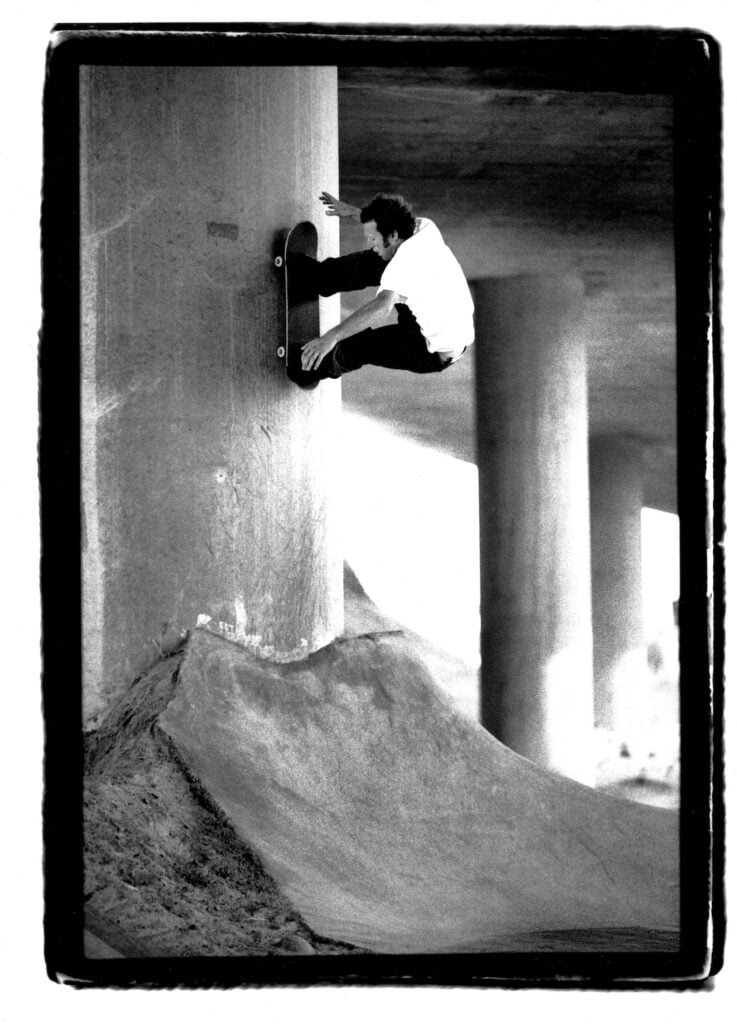
That handmade instinct runs through San Diego’s skate history. In 1973, Encinitas surfer Frank Nasworthy, using tips from waiting tables, introduced Cadillac Wheels, the urethane wheels that helped revive skateboarding. In 1977, Tom Stewart built a wooden half-pipe in his Encinitas front yard and sold the plans for $19.95, reaching, by his count, every state and 30 countries. In 1999, the rebel DIYers started pouring their own concrete under the bridge at Washington Street. The city shut it down; the skaters fought back—and won. The park is still there and maintained by volunteers. I drive past it all the time and never knew.
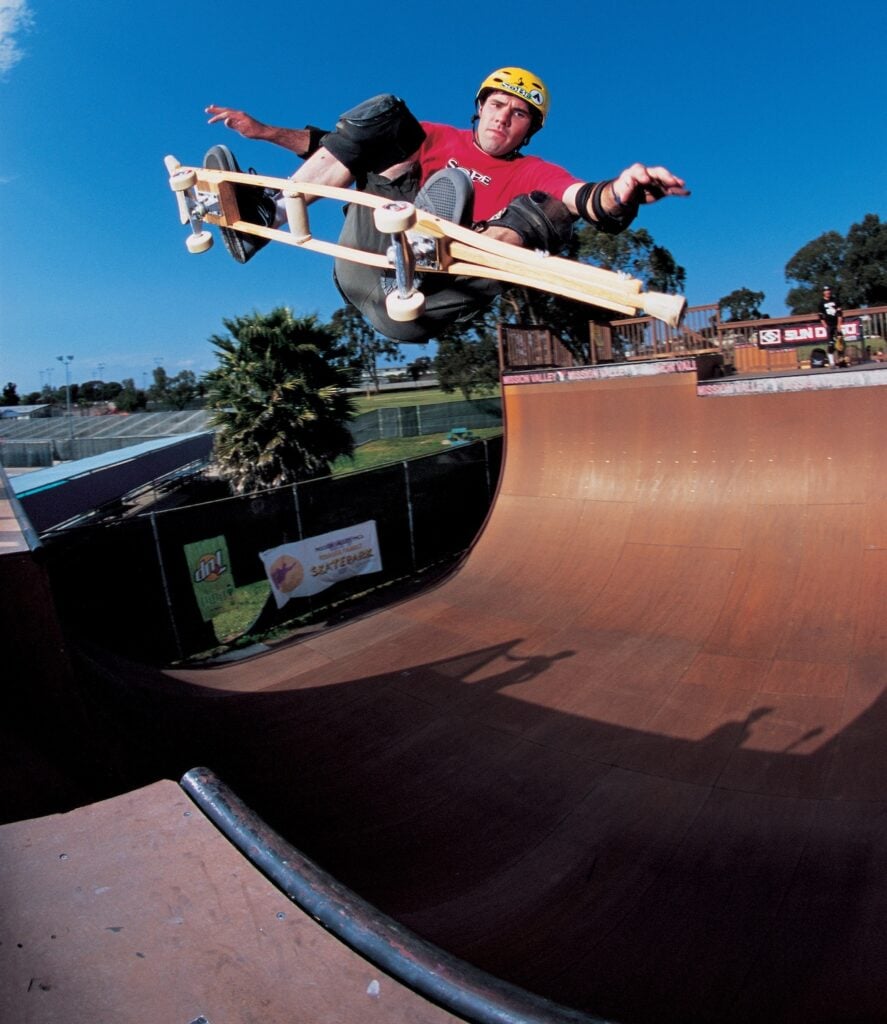
“Skate Craft,” a bonanza of childlike elation and DIY ingenuity, brings together more than 200 objects, organized into five sections: boards, gear, obstacles, tools, and upcycled objects. There’s a crutch board, a repurposing of the utilitarian tool Andy Macdonald used while recovering from a skate injury. There are “Frankenstein tools”—sanders and other equipment rigged to do jobs they were never designed to do—and old decks reborn as furniture, musical instruments, and dishware. Mendoza also landed a 1966 Vans Authentic sneaker and the Smithsonian’s waffle mold that made its sole.
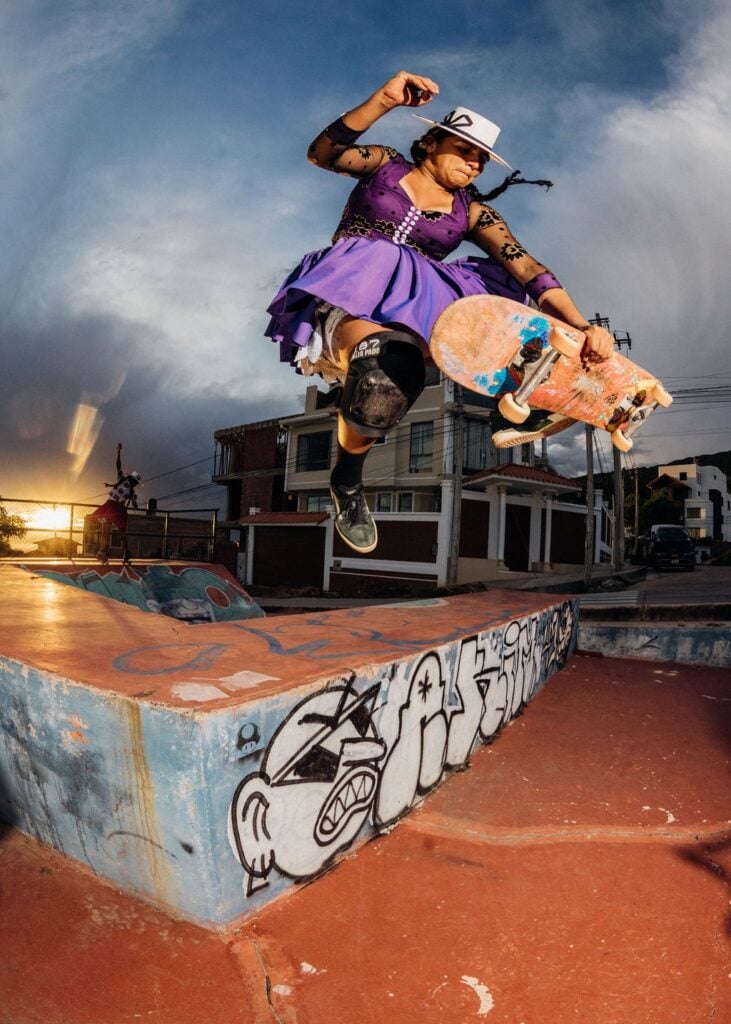
The makers include ImillaSkate, a collective of Indigenous Bolivian women who skate in traditional pollera skirts; and skater/artist Lia Halloran, whose “Dark Skate” photographs are pure DIY invention. She straps a light to her body, skates in the dark, and leaves the camera shutter open, sometimes for as long as 45 minutes. The results sit somewhere between photography, performance, and night magic.
The display fixtures are as DIY as what they’re meant to feature. Exhibition designer Jerry Maloney and preparator David Leroi built the mounts from materials already lying around the museum’s workshop. Their up-and-down rail, a nod to a skater’s flow and the stair rails skaters grind, holds skateboards as if they’re dropping in or flying through the air. Mendoza wanted every deck to be seen from all sides, marks and scars included. There’s also a “pedestal pile,” the museum’s own display furniture stacked like a makeshift street ramp, a deck Leroi made from the old Mingei’s floorboards, and title-wall letters that Hall of Famer Paul Schmitt cut from recycled skateboards.
The programming is equally exciting: curator-led tours, a two-day workshop to build your own board with Schmitt, a February 12 panel with local icon Tony Hawk, and a free Community Day on April 3 with ramp demos, a skate clinic, and a fashion show.
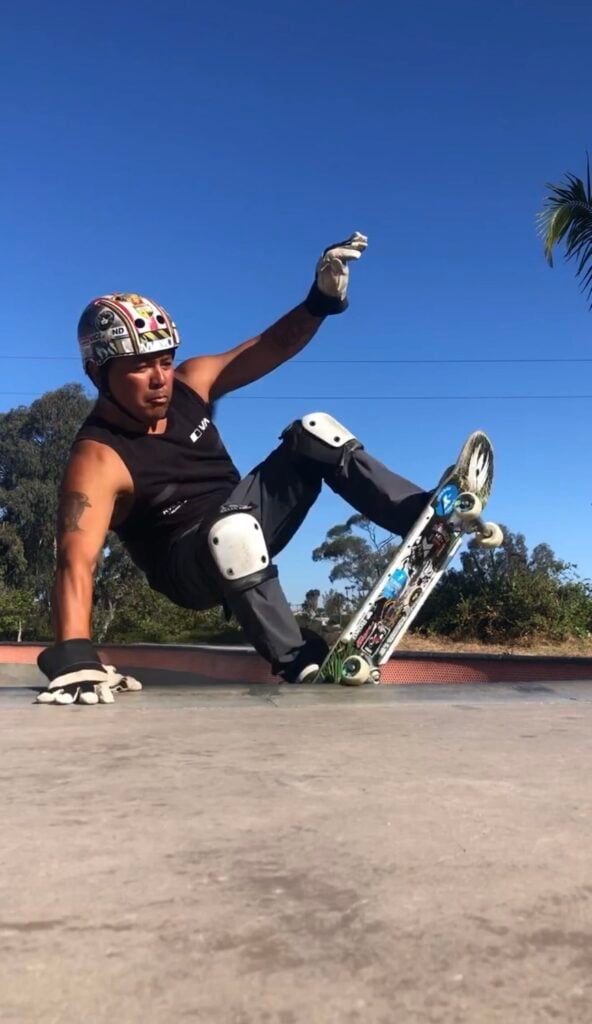
When I ask Mendoza whether it’s scary to be handed a show to curate, he answers like a skater. “Everything skateboarding is scary, and skateboarding hurts,” he says. It’s given him two dislocated elbows and, by his count, “over 20 concussions.” What keeps him coming back is the moment a maneuver finally comes together—“a make”—when body and board click after all that failing.
When Hanna mentions poet and novelist Ocean Vuong, I perk right up. Skate culture was among his first artistic practices, and he has carried its appetite for risk onto the page. “Landing the trick is a miraculous moment of cosmological agreement with gravity, physics, and time,” he told podcaster David Perell; more often, though, “all you have is bruises and a broken ankle. There’s not even a payoff, and yet there is a delight in doing it with your friends and seeing your body move through space.” Coming from a family of factory and nail salon workers, Vuong says, simply getting to write books felt like a gift, “so why not risk everything? Why wouldn’t I relentlessly throw myself off an eight stair?”
Apparently, I relentlessly throw myself off a metaphorical eight stair. Middle-age fear means I probably won’t skate in this life. But I think about the younger, Moe Szyslak me glaring at some kid who wouldn’t stop launching herself from the same handrail, and I understand now that I was watching a maker at work, a person working something out, somebody doing what everyone in this show has done: fail over and over until they didn’t. The hollering I found so jarring was applause, praise, and solidarity—and I have tons of it for this show.
“Skate Craft: Do-It-Yourself Design in Skateboarding” is on view November 21, 2026, through May 9, 2027, at Mingei International Museum in Balboa Park.
The post Tony Hawk, Vans, and the DIY Roots of Skateboarding Come to the Mingei appeared first on San Diego Magazine.
Categories
Recent Posts




GET MORE INFORMATION